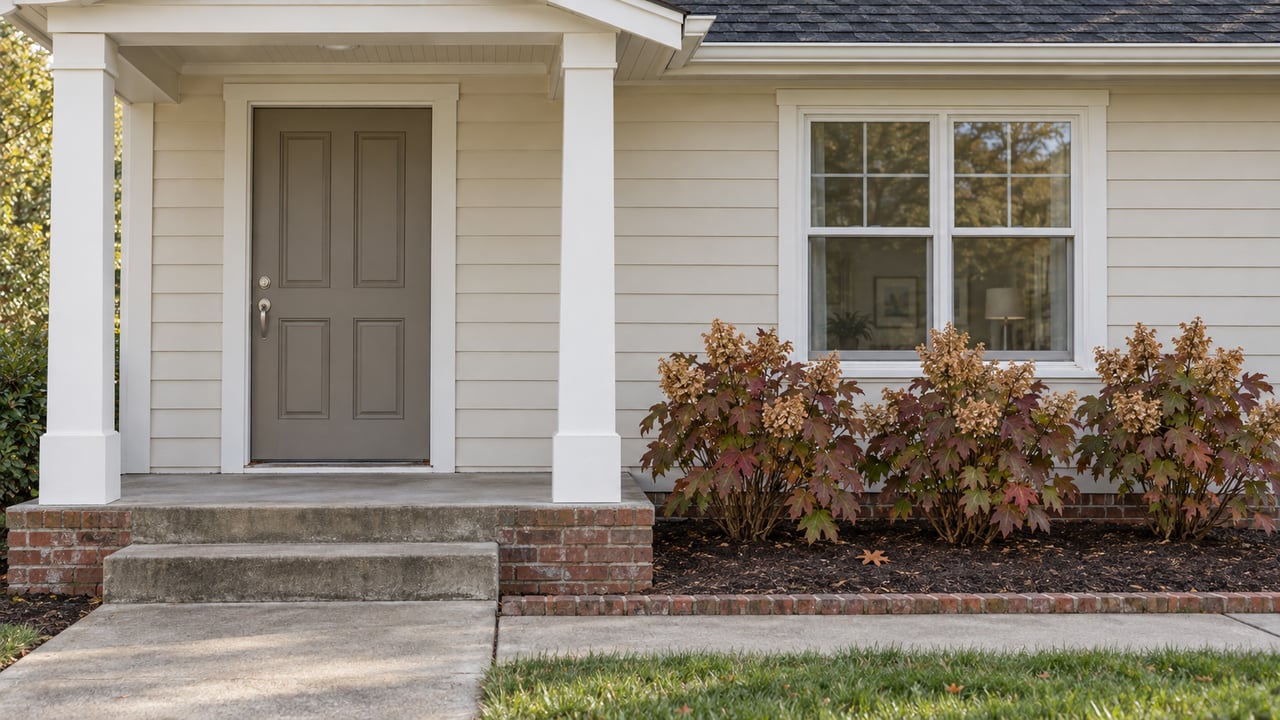
When you walk a White House backyard, look for a round lid two or three feet across set flush with the grass. If you find one, also look for a small electrical box nearby with a red light on it. That lid and that box tell you the house sends its wastewater through a low-pressure grinder pump, not by gravity. In White House, that describes a large share of homes.
As of the City's August 2026 Wastewater Department report, White House has 8,122 sewer connections. Of those, 3,011 are low-pressure grinder connections, 450 are vacuum connections, and 4,661 are gravity. That works out to more than 4 in 10 connections running on equipment with moving parts. Most buyer guides treat a grinder pump as a homeowner liability, an expensive appliance buried in the yard. The City of White House has set things up differently, and that shifts which questions belong on your due diligence list.
The City Starts Maintaining at the Tank
The most useful sentence for a White House buyer is on the City's own wastewater FAQ page. It covers grinder and vacuum service:
"our maintenance begins at the tank (the line between the house and the tank is your private property, but everything from the tank to the treatment plant is serviced by the City)."
For a gravity connection, the City's maintenance starts at the 6-inch cleanout, which the City says is usually near the property boundary.
So on a grinder home, the City services the pump, the tank and everything downstream of it. The same FAQ says that if slow drains turn out to be a problem with a City-maintained grinder pump or vacuum valve pit, the City repairs it free of charge. If the problem sits between the City's maintenance point and the building, the department tells the resident to call a plumber. The City also says a service call doesn't cost anything beyond the normal sewer bill. It does reserve an extra charge for deliberate damage, such as a tank someone drove over, or repeated flushing of banned items after a crew has already warned the resident. The City says response usually takes no more than two hours, and it's often faster during business hours.
That turns the usual grinder pump question around. In White House, a pump's age matters much less than the condition of the private line feeding it and the state of the ground around the tank.
Three Systems, Two Places Where City Maintenance Starts
Here's how the three connection types compare, using the City's descriptions and its fiscal 2025/26 service call counts.
| Connection type | What you see in the yard | Where City maintenance starts | Connections, Aug. 2026 | Service calls, FY 2025/26 |
|---|---|---|---|---|
| Gravity | Usually two cleanouts, a 4-inch near the foundation and a 6-inch near the road or property edge | The 6-inch cleanout | 4,661 | 43 |
| Low-pressure grinder | Round 2 to 3 ft tank lid plus an electrical control panel with a red alarm light | The tank | 3,011 | 851 |
| Vacuum | Round tank lid with no alarm panel | The tank | 450 | 227 |
The service call column shows why the maintenance boundary matters. White House's grinder network logged 851 low-pressure service calls in fiscal 2025/26, about 28 for every 100 grinder connections. The vacuum network logged 227 calls on roughly 450 connections, about one call for every two connections. Gravity connections logged 43. These pumps need regular attention, and the City's crews are the ones doing that work.
The City's report is open about vacuum service being the harder system to run. White House owns two vacuum networks: Calista, with about 250 connections, and North Palmers, with about 200. When vacuum pressure drops anywhere in a network, it drops across the whole network, and the connections farthest from the station feel it most. The department plans to convert about half of the Calista network to grinder service. The first focus area is Hamlett Drive, Skyline Drive, Hillwood Drive and Kennedy Drive. As of August 2026, design was nearly finished and construction was planned around the turn of the year. If you're looking at a home on one of those streets, ask the City where that project stands for that particular address.
What Winter Storm Fern Showed About Pump Supply
Since the City replaces pumps, its pump inventory matters to every grinder household. TVA's storm update has Winter Storm Fern moving out of the Tennessee Valley on January 25 and 26, 2026, with extreme cold hanging on behind it.
According to the City's August 2026 report, the wastewater department budgeted for about 350 new E-One grinder pumps in fiscal 2025/26 but needed 542 to keep up with service calls. The report says the pumps damaged during Fern made that gap much worse. To cover it, the department rebuilt 81 pumps in-house, put 123 warranty-return pumps back in stock, and got supplemental funding for 76 more new pumps.
For fiscal 2026/27, the department budgeted for about 420 new pumps and expects to need 475 to 500, with warranty returns filling the difference. It puts the operating life of a new pump at roughly 7 to 10 years, compared with 2 to 3 years for a rebuilt one. The adopted FY 2027 budget includes $600,000 for E-One grinder pumps and $50,000 for Grundfos and Zoeller pumps. When a pump fails in a White House yard, the City is the one paying for and installing the replacement.
The Part of the System You Take On
A grinder home in White House leaves the owner with three areas of responsibility, and each one can be checked before closing.
The private line. The pipe from the house to the tank belongs to the owner. If the City finds the problem is on the house side of the tank, the fix is a plumber's job. A home inspection doesn't automatically cover that segment. Ask your inspector what they can evaluate between the foundation and the tank, and whether a separate sewer line specialist makes sense for that house.
Access to the tank. White House Municipal Code Title 18, Section 18-204(8), prohibits structures that get in the way of access to City-maintained sewer equipment, or of servicing or removing it. The code also requires an obstruction to be removed after notice. Section 18-212 gives the wastewater director and authorized representatives a right of entry for inspection. Before you close, note what sits near the lid. If you have questions about anything built close to the tank, or you're planning a project nearby, the wastewater department is the place to ask.
What goes down the drain. The City's grinder pump FAQ lists items not to flush: baby and cleaning wipes, feminine or male hygiene products, diapers, fats, oils and grease, paint, paper towels, cotton and fabric, bandages, and contact lenses. The City says wipes labeled "flushable" are banned too, on every connection type. This matters in a practical way. Code Sections 18-204(13) through (16) allow charges for damage to City-owned equipment, for foreign material and pump station breakage, and for owner abuse or neglect. The FAQ's plain-language summary describes extra charges in terms of deliberate damage, and both the FAQ and the code text are linked here so owners can read them in full.
When the alarm goes off, the City's instructions are to call 615-672-3654 right away, at any hour, and stop using water. That means no flushing, no dishwasher, no washing machine and no shower, so wastewater doesn't back up into the house. The City also asks residents to report sewer problems by phone, not through its app.
A Pre-Closing Walkthrough for a White House Home
- Find the connection type. A tank lid with an alarm panel nearby means grinder. A tank lid with no panel means vacuum. Two cleanouts and no tank means gravity. If you can't tell, the City's FAQ invites you to call and ask.
- On a grinder home, check that the alarm panel is visible and that its red light is off.
- Walk from the foundation to the tank and note anything built over that path or crowding the lid.
- Ask the sellers for any history of alarms or service visits. The City handles those calls, so any history is on record with them.
- If the address is on Hamlett, Skyline, Hillwood or Kennedy Drive, ask the wastewater department how the Calista conversion schedule applies to it.
For New-Construction Buyers: Capacity Isn't the Bottleneck
When a town grows as fast as White House has, buyers often ask whether the sewer system can keep up. The City's new treatment plant is fully online and designed for a sustained 2.000 million gallons per day. In August 2026, average influent was 1.307 MGD, or 65.4 percent of design. Once the sustained average passes 80 percent, or 1.600 MGD, the City is legally required to start designing the next expansion. The August report says design work on a new Headworks facility and expanded equalization has begun. The FY 2027 capital plan sets aside $1 million for that line item. The City permitted 402 new connections in fiscal 2025/26.
What did change in 2026 is the price of connecting and of monthly service. Ordinance 26-04 passed on second reading June 18, 2026. It raised the single-family wastewater capacity fee from $5,000 to $5,500, payable before construction of the individual service connection. It also raised the residential monthly rate from $22.74 fixed plus $9.82 per 1,000 gallons to $23.42 fixed plus $10.11 per 1,000 gallons. On a build, ask how the builder's contract handles utility connection fees.
This post is general information, not legal or financial advice. Confirm the details for your specific property with the City of White House and the right professionals.
Quick Answers
Will I pay to replace a failed grinder pump in White House? According to the City's FAQ, normal wear-and-tear repair or replacement of City-maintained equipment comes at no extra charge. Extra charges are for deliberate damage.
Can I look up my sewer type online? The City offers a visual guide and a phone line, 615-672-3654, for questions about your connection type.
Does a vacuum connection work like a grinder? The City maintains both starting at the tank, and the yard equipment looks alike. The difference is the alarm panel, which grinder units have and vacuum pits don't.
Jacqueline spent years in construction management, and checking what's buried in a yard is part of how she approaches every inspection. If you're under contract in White House, or picking a lot in a new subdivision there, Jacqueline Brown can walk the property with you, find the tank, note what's around it and set up the right follow-up inspection before your option period ends. Book a Call and send her the address.